Understanding The Catholic Funeral Process
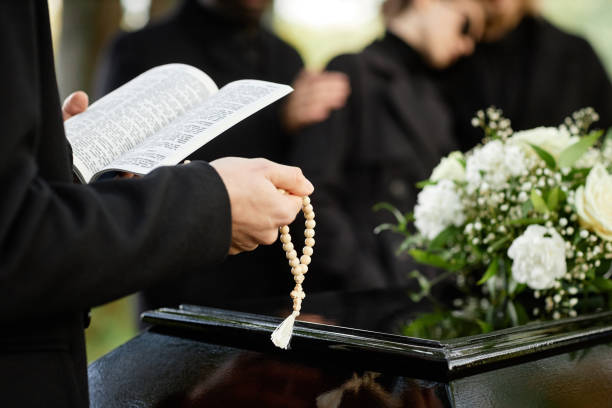
The primary reason that we as Catholics have funerals for those who have died is to pray for them. We pray for the repose of their soul, that their soul may be purified so they might enter into their heavenly homeland.
“At the death of a Christian, whose life of faith was begun in the waters of baptism and strengthened at the eucharistic table, the Church intercedes on behalf of the deceased because of its confident belief that death is not the end nor does it break the bonds forged in life. The Church also ministers to the sorrowing and consoles them in the funeral rites with the comforting word of God and the sacrament of the eucharist.
Christians celebrate the funeral rites to offer worship, praise, and thanksgiving to God for the gift of a life which has now been returned to God, the author of life and the hope of the just. The Mass, the memorial of Christ’s death and resurrection, is the principal celebration of the Christian funeral.” (Order of Christian Funerals: General Introduction)
📖 The Catholic Church offers three sequential funeral rites, which provide those who are mourning a way to prepare themselves spiritually and emotionally, to say their goodbyes.
- Vigil prayers generally occur fifteen minutes prior to visitation at the funeral home when immediate family is gathered. In this service, the priest, deacon, and/or bereavement minister will include Scripture reading, prayers, and petitions for both the deceased and the grieving family.
- The core of the Catholic funeral celebration is the Mass, called the “Mass of Christian Burial.” The Eucharist is at the center of the Catholic faith – the celebration of the death and resurrection of Jesus Christ. Scripture readings and prayer also play a prominent role in the Catholic funeral Mass, along with songs, hymns, and a brief homily. Members of the family are encouraged to assume the role of placing the pall, reading Scripture, and presenting the offertory gifts.
- The Rite of Committal, referred to as burial, interment, or graveside service, is the last farewell in which the Christian community honors one of its members before the body is buried. With priest and mourners accompanying the body to the cemetery, the rite is celebrated at the grave.
Additional Considerations That May Apply
Cremation
It has been traditional for Catholics to bury their dead in cemeteries immediately after the funeral. However, some families have chosen cremation. Since 1963, the Catholic Church has allowed cremation.
- The Church prefers the cremation occur after the funeral. This allows display of the body during the wake/visitation, and the body will be present during the funeral mass.
- Choosing cremation does not mean that you cannot have a Catholic funeral Mass. If cremation is necessary before the service, ashes should be in an urn and displayed in a prominent place during the service.
- The Church teaches that the ashes should be buried in an approved cemetery as soon as possible, rather than kept in a home. If you have ashes at home, please contact the office to arrange proper burial.
- Why should the ashes of our loved ones not be scattered or divided?
Although the body begins to experience corruption and disintegration after death as a consequence of sin, we believe that the body will rise again and be glorified. In our earthly life, we acknowledge the unity of the body (if your tooth hurts, for example, in a very real way, your whole body hurts). It is fitting, therefore, that even in death we continue to treat the body as a unity. Additionally, because it is the same body that we have on earth that will rise again, we treat this body with all due dignity.
Funeral Liturgy Outside Of Mass
There may be instances when a funeral liturgy will be celebrated outside of the Mass and may be conducted in the church or the funeral home. Following careful consideration of the deceased's relationship with the Church and the needs and wishes of the bereaved family, the pastor may offer a funeral liturgy outside Mass.
Burial With A Spouse Who Is Not Catholic
Whenever possible, those who were part of the Catholic community are buried in a Catholic cemetery.
- When a Catholic is to be interred in a cemetery other than a Catholic cemetery, the priest will bless the cemetery plot and then follow the usual ritual.
- When a non-Catholic is to be buried in a Catholic cemetery, the minister of the deceased’s faith community may conduct the burial service, with the pastor's permission, according to the minister's own ritual.
- If the family of the non-Catholic deceased person requests a Catholic priest to conduct the burial service, the priest will celebrate an appropriate rite.